What happens when a woman stops dating to be chosen and starts dating to discover who she is, what she wants, and whether a man is actually right for her?
After a painful relationship experience, she began a journey that would take her on 60 first dates.
But the most fascinating part of her story isn't how many men she met. It's what she discovered about herself along the way.
She learned to recognize her preferences, communicate her boundaries, say no when something didn't feel right, and pay attention to how she felt around the men she met instead of constantly worrying about how they perceived her.
And yet, there was something she didn't expect.
Dating became relatively easy when she wasn't particularly interested in the man. She could meet someone, enjoy the experience, and decide whether she wanted to see him again.
But when she met someone she genuinely liked, everything changed.
Suddenly, she became more aware of her fears. She was afraid of showing herself, afraid of rejection, and even afraid that the connection might actually work.
In this conversation, Juliana explores what happens when dating becomes more than simply finding someone. Together, they discuss the difference between discovering what you want in a relationship and allowing yourself to experience genuine emotional intimacy.
Because dating isn't just about finding the right man.
It's also one of the ways you discover yourself, understand your patterns, and learn to make different choices in love.
What Happens When You Stop Dating to Be Chosen?
For many women, dating can become an ongoing effort to figure out whether a man likes them.
You notice how he communicates, whether he initiates, how quickly he responds, and whether his behavior suggests he's interested. You might replay conversations, analyze small changes, or wonder whether you said something that made him lose interest.
Without realizing it, your attention becomes centered on how he perceives you.
But what happens when you start asking a different question?
Instead of wondering, Does he like me? you begin asking, How do I feel around him?
Do you enjoy spending time with him? Do you feel comfortable being yourself? Do you like the way he communicates? Are you genuinely interested in getting to know him?
This shift changes the way you approach dating.
You're no longer simply waiting to see whether someone chooses you. You're also discovering whether you would choose him.
That was one of the biggest changes throughout her dating journey. As she went on more dates, she became increasingly aware of her own preferences and what she wanted from the experience.
And that brings us to something important: every date doesn't need to lead to a relationship to be valuable.
Sometimes, dating helps you discover what you enjoy, what doesn't feel right, and what you no longer want to compromise on.
What 60 First Dates Can Teach You About Yourself
She went on 60 first dates since February.
But the number itself isn't the most important part of her experience. What matters is how much she learned about herself through those dates.
Initially, she struggled to get started. Even after joining the program, she resisted the process for a while. She wasn't immediately excited about dating apps or putting herself out there.
Eventually, she began approaching dating more like an experiment.
Instead of expecting every date to become something meaningful, she allowed herself to discover what she actually enjoyed.
She realized that going to bars wasn't her preference. She preferred walks. She learned what kinds of conversations she enjoyed, what made her feel comfortable, and what she wanted to communicate before meeting someone.
She also became more comfortable saying no.
If she wasn't interested in someone, she didn't need to keep going just because a date had happened or because the man wanted to see her again.
These experiences helped her understand that dating isn't only about evaluating whether someone likes you. It's also about noticing whether you like the experience you're having with that person.
The more connected you become to your own preferences, the easier it becomes to recognize what genuinely feels right for you.
Why Dating Can Feel Easy Until You Meet Someone You Actually Like
Here's where her story becomes particularly interesting.
She found that dating men she wasn't especially interested in was relatively easy.
There wasn't as much to overthink. She could show up, get to know someone, and decide whether she wanted to see him again.
But when she met a man she genuinely liked, something shifted.
She became afraid of showing herself. She worried that he might not like what he saw. She found herself becoming more protective and taking longer to express what she was feeling.
And perhaps the most surprising realization was that she was also scared that it might actually work.
This is an important distinction.
Sometimes, we assume that the biggest challenge in dating is dealing with rejection. But genuine connection can bring up a different kind of vulnerability.
When you actually like someone, there's more at stake emotionally. You might have to let him see parts of yourself that you usually keep private. You might have to communicate your interest, allow him to get closer, and accept that you cannot completely control how the connection develops.
You may want a relationship, but when the possibility becomes real, another part of you might want to pull back.
And that's worth paying attention to.
Because sometimes, the challenge isn't that you don't know how to date. It's that allowing someone you genuinely like to get close requires a different kind of openness.
Learning to Trust Yourself: Boundaries, Preferences, and What Feels Right
As she continued dating, she became more aware of what she wanted and what didn't feel right for her.
She learned to communicate her preferences, suggest activities she actually enjoyed, and say no when she wasn't interested.
This is an important part of developing self-trust.
You don't have to agree to every date suggestion. You don't have to continue seeing someone simply because he likes you. And you don't have to convince yourself that a connection is right just because it looks good on paper.
You can pay attention to how you feel.
Do you enjoy the conversation? Do you feel comfortable? Are you interested in seeing him again? Does the experience feel aligned with what you want?
These questions bring your attention back to your own experience.
But there's also another side to boundaries.
Sometimes, the things we call boundaries are actually protective responses. We might hold back because we're afraid of rejection, avoid expressing interest because we don't want to appear too invested, or create distance when someone starts becoming emotionally important.
The distinction matters.
A healthy boundary protects what is important to you. A protective wall can sometimes prevent you from experiencing the connection you actually desire.
The goal isn't to lower your standards or ignore your boundaries. It's to understand what is motivating your reactions.
Are you stepping back because something genuinely doesn't feel right? Or are you stepping back because allowing yourself to get closer feels uncomfortable?
Learning to recognize the difference can change the way you experience dating.
When Small Changes in Communication Feel Like Rejection
Another important part of her journey involved how she interpreted communication.
She shared that she used to attach a lot of meaning to small changes. A missing smiley face could make her wonder whether someone no longer loved her. A missing good morning message could suddenly feel like something was wrong.
When someone's communication changed, her mind could quickly turn that into a story about rejection.
Many women recognize this experience.
You might notice that a man takes longer to respond, doesn't initiate as often, or communicates differently than he did before. And before you know it, you're wondering whether you did something wrong.
But there's a difference between what actually happened and the meaning you give it.
Someone hasn't sent a message. That's what happened.
The story might be that he's lost interest, that you've said something wrong, or that you're about to be rejected.
Those things aren't automatically the same.
Throughout her journey, she became better at separating the situation from the interpretation. For example, if someone disappeared before they had even met, she began seeing that as information about the connection rather than proof that something was wrong with her.
This doesn't mean ignoring someone's behavior or pretending disappointment doesn't matter.
It means recognizing that not every interaction is a reflection of your worth.
Someone else's decision, communication style, or lack of interest does not determine how valuable you are.
The Inner Conflict Between Wanting Love and Protecting Yourself
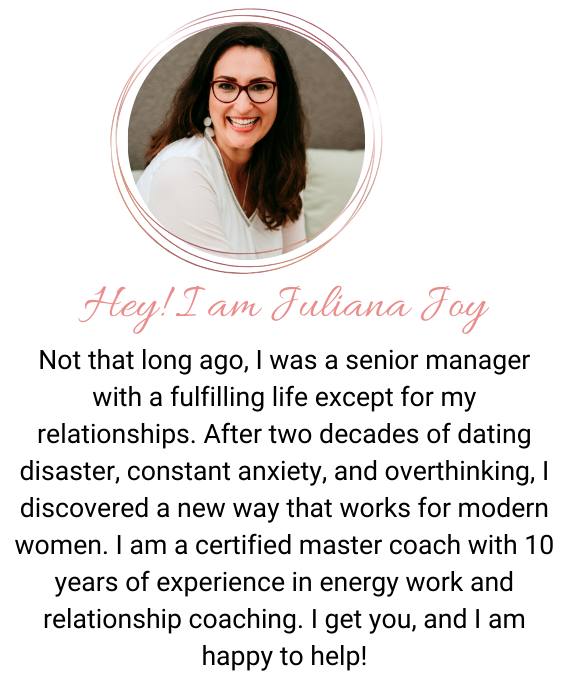
One of the deeper moments in Juliana's conversation is when they explore the different internal voices that show up when she starts developing feelings for someone.
She describes it almost like having an internal board meeting.
One part of her wants to see where the connection goes. Another wants to maintain her boundaries. Another wants reassurance. And another is already thinking about how she might get hurt.
It's a familiar push and pull.
You want someone to get closer, but you also want to protect yourself. You want to express your feelings, but you worry about being rejected. You want to experience love, but you don't want to lose the security of being in control.
These different parts don't necessarily want the same thing.
Some are looking for connection. Others are trying to maintain safety and prevent disappointment.
The challenge isn't that these parts exist. It's understanding how they influence the way you show up when dating.
Sometimes, the response that feels protective in the moment can also keep you from expressing what you genuinely want.
You might take longer to respond, hold back your feelings, or create distance even when another part of you wants to move closer.
Recognizing these internal reactions gives you an opportunity to respond differently instead of automatically following every protective impulse.
Emotional Vulnerability: The Next Level of Your Dating Journey
Her experience shows that learning to date and learning to become emotionally vulnerable are not necessarily the same thing.
Through her 60 first dates, she became more comfortable meeting people, discovering her preferences, communicating her boundaries, and recognizing what she wanted.
But when she met someone she genuinely liked, a different kind of growth became necessary.
She had to become more aware of her feelings and the parts of herself she had previously hidden or masked.
She also began recognizing how difficult it could be to express emotions and give herself time to understand what she was experiencing.
This is an important part of the journey.
You can know your standards, have a successful career, maintain your independence, and feel confident in most areas of your life. And still, allowing someone to see the more vulnerable parts of you can feel unfamiliar.
Emotional vulnerability doesn't mean becoming dependent on someone else. It doesn't mean abandoning your boundaries or giving up the life you've built.
It means allowing yourself to experience connection without constantly needing to manage, control, or protect every part of the experience.
You can be independent and still desire partnership.
You can have high standards and still allow someone to get close.
You can be strong and still let yourself be seen.
And sometimes, the next level of growth isn't about becoming better at protecting yourself. It's about learning when you can allow yourself to open up.
You Don't Have to Finish Healing Before You Start Dating
One of the ideas at the heart of Juliana's Hello to Committed philosophy is that you don't necessarily have to finish healing before you start dating.
You can also learn and grow through dating.
Every experience gives you an opportunity to notice something about yourself. You might recognize a pattern you hadn't seen before, discover a preference you didn't know you had, practice communicating a boundary, or become aware of what happens internally when you meet someone you genuinely like.
Of course, this doesn't mean forcing yourself to date when you're not ready or ignoring experiences that don't feel right.
It means understanding that dating doesn't have to be a test of whether you're good enough to be chosen.
It can be an opportunity to get to know yourself better.
You don't have to approach every date with the expectation that it needs to lead somewhere. You can stay curious, pay attention to your experience, and make choices based on what you genuinely want.
And as you become more connected to yourself, you may begin approaching relationships from a very different place.
Final Thoughts: Stop Asking Only Whether He Chooses You
Her journey began with a painful relationship experience and a desire to understand what had happened.
But along the way, something shifted.
Instead of focusing so much on one man and whether he would choose her, she began discovering what she wanted, how she felt around different men, and what kind of relationship would actually feel right for her.
Her 60 first dates weren't simply about meeting more men. They became an opportunity to learn about herself.
And her story also reminds us that the journey doesn't end when you become more comfortable dating. When you meet someone you genuinely like, there's another opportunity to understand yourself, recognize your protective responses, and practice allowing genuine connection.
So perhaps the question isn't only:
Does he like me?
It's also:
Do I like how I feel with him?
Can I be myself around him?
Am I allowing him to get to know me, or am I protecting myself so much that he never gets the chance?
And most importantly:
Am I choosing this connection because it feels right for me, or because I want to be chosen?
You don't have to become less independent, less ambitious, or less capable to experience love.
You can build a life you love and still make space for someone to share it with you.
Because dating isn't just about finding the right person. It's also about discovering who you are and learning to choose from that place.
If you'd like to hear her full story, watch or listen to the podcast conversation with Juliana on YouTube, Spotify, or your favorite podcast platform.
And if this article resonated with you, share it with another woman who is learning to approach dating and relationships differently.
Ready to Understand Your Relationship Patterns and Create a Different Experience in Love?
By now, you might be recognizing parts of yourself in this story.
Perhaps you've noticed that you feel confident and in control in most areas of your life, but romantic relationships bring out a different side of you. Maybe you find yourself overthinking his messages, holding back when you actually want to get closer, or wondering why you keep experiencing similar patterns in love.
But what if these reactions aren't random?
What if understanding the patterns behind the way you approach relationships could help you make different choices and create a different experience in love?
Start by discovering your Relationship Archetype.
Juliana's free Relationship Archetype Quiz helps you explore the relationship patterns influencing the way you experience love, connection, and dating.
It's an opportunity to gain a deeper understanding of yourself, recognize the dynamics you may be repeating, and begin seeing your relationships from a new perspective.
👉 Discover Your Relationship Archetype
Ready to Go Deeper?
Understanding your patterns is an important first step. But if you're ready to explore what's underneath them and begin creating a different experience in your relationships, the Bring Him Closer Experience™ is your next step.
Inside, you'll explore the deeper patterns influencing how you approach love, emotional connection, and the relationship you desire.
Because the goal isn't to keep repeating the same experiences and hoping for a different outcome. It's to understand yourself more deeply and begin approaching love differently.
👉 Explore the Bring Him Closer Experience™
You don't have to keep approaching love the way you always have. You can understand your patterns, make different choices, and create space for the relationship you truly desire.
Connect with Juliana on Instagram: @julianajoycoach